
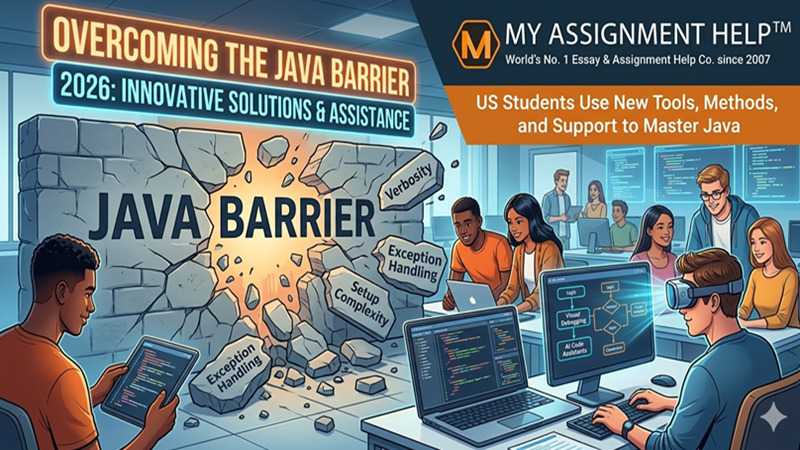
For decades, Java has been the bedrock of Computer Science (CS) curricula across the United States. From the halls of MIT to the sprawling campuses of the University of Texas, it remains the primary language for teaching Object-Oriented Programming (OOP). However, the “Java Barrier”—the steep learning curve characterized by verbose syntax, strict typing, and complex memory management—has historically been a primary reason for high attrition rates in introductory programming courses.
As we move through 2026, a significant shift is occurring. Data suggests that while CS enrollment is at an all-time high, the “weed-out” effect of Java is finally beginning to wane. This isn’t because Java has become simpler; rather, the ecosystem surrounding student support, pedagogical methods, and technical tooling has undergone a massive evolution to meet the needs of the modern learner.
The Evolution of the Learning Curve
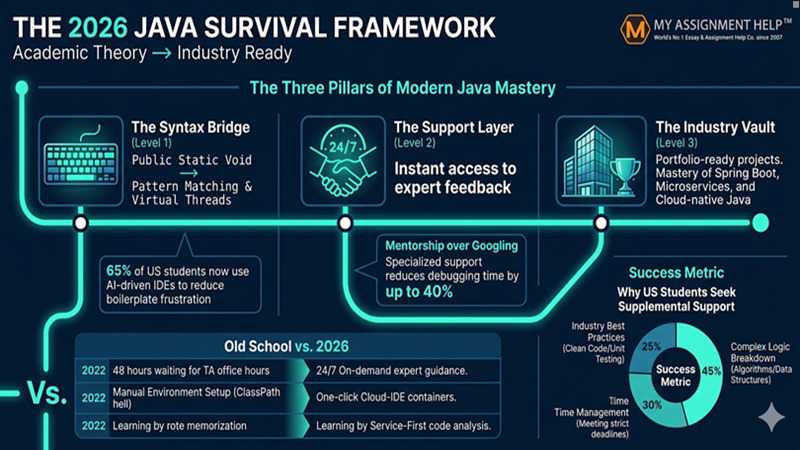
In 2026, the traditional struggle with public static void main(String[] args) is being met with sophisticated AI-integrated IDEs and personalized learning paths. US universities have moved away from “sink or swim” methodologies, adopting a more modular approach to software engineering. Yet, despite these advancements, the conceptual leap required to master multithreading, garbage collection, or complex data structures remains a formidable hurdle.
Many students find that supplementary instruction is the only way to bridge the gap between classroom theory and industry-grade application. By leveraging a professional assignment writing service, students are gaining access to structured breakdowns of complex logic. This allows them to visualize the execution of code rather than just memorizing syntax, transforming the “Java Barrier” into a stepping stone toward architectural fluency.
The Economic Driver: Why Java Persists
The resilience of Java in the US education system is driven by market demand. In 2026, Java remains one of the top three most requested languages in enterprise-level job postings, particularly in the fintech, healthcare, and defense sectors. The language’s “write once, run anywhere” philosophy has evolved into “scale anywhere” with the maturation of cloud-native Java frameworks. This economic reality keeps the language relevant, forcing students to find innovative ways to bypass the initial frustration of the learning curve to secure high-paying roles in the Silicon Valley and Silicon Alley ecosystems.
Bridging the Gap: Peer-to-Peer and Expert Support
One of the most significant trends in 2026 is the democratization of expert mentorship. The isolation of the “all-nighter” in a computer lab is being replaced by on-demand technical assistance. For instance, when a student is stuck on a recursive function or a Spring Boot integration at 2 AM, they no longer have to wait for office hours that might be days away.
Services offering specialized java assignment help provide a lifeline, offering real-time debugging and architectural guidance that mimics the pair-programming environment found in modern tech companies. This shift from “tutoring” to “collaborative debugging” has significantly lowered the psychological barrier to entry for many first-generation CS students.
The Role of Visualization in 2026
Traditional lectures are being replaced by interactive visualizations. In 2026, students use augmented reality (AR) tools to “step into” the Java Virtual Machine (JVM), seeing how objects are allocated in the heap and how the stack manages method calls.
By visualizing the JVM, the abstract nature of Java becomes tangible. Students can see the “Garbage Collector” in action, which demystifies why certain code runs efficiently while others trigger an OutOfMemoryError.
Data-Driven Insights: Why 2026 is Different
Recent educational surveys indicate a 15% increase in retention rates for CS majors compared to 2022. Several factors contribute to this:
- Generative Debugging: Tools like GitHub Copilot and custom academic LLMs help students explain why a “NullPointerException” occurred, rather than just fixing it.
- Cloud-Based IDEs: The “Environment Setup” nightmare of the past is gone. Students now use pre-configured containers that ensure their code runs exactly the same on a Chromebook as it does on a high-end MacBook Pro.
- Micro-Credentialing: Students are breaking their learning into smaller, manageable certificates—such as “Java Collections Framework Mastery”—before tackling full-scale university projects.
| Category | 2022 Challenges | 2026 Solutions |
| Syntax | Verbose and intimidating | AI-powered boilerplate generation and Pattern Matching |
| Environment | Complex Path/ClassPath setup | Cloud-native IDEs (Gitpod, Codeanywhere) |
| Support | Limited to TA office hours | 24/7 Expert specialized platforms |
| Outcome | High burnout/major switching | Higher retention through modular, supported learning |
The “Industry-Ready” Requirement
The US job market in 2026 doesn’t just want someone who can write a “Hello World” program. Companies like Amazon, Google, and various Wall Street firms require mastery of Java 21+ features, including Virtual Threads (Project Loom) and Scoped Values. The “Java Barrier” has shifted from “how do I write a class?” to “how do I optimize high-concurrency systems?”
To overcome this, students are increasingly looking at “Service-First” learning. This involves analyzing professionally written code to understand best practices in documentation, unit testing (JUnit 5), and Clean Code principles. By studying high-quality samples, students learn the “dialect” of professional Java, which is often missing from academic textbooks.
Strategic Interlinking and Academic Integrity
As the landscape changes, the focus on academic integrity has intensified. US institutions are utilizing advanced AI-detection and plagiarism software. Consequently, the way students use external services has evolved. Rather than seeking “shortcuts,” students use these platforms as comprehensive reference guides. They submit their logic to experts to receive feedback on efficiency, security, and scalability—skills that are essential for the 2026 workforce but often under-taught in massive open online courses (MOOCs).
Key Takeaways for Mastering Java
- Embrace Modern Tooling: Use IntelliJ IDEA with advanced telemetry to catch memory leaks early.
- Focus on Logic, Not Just Syntax: Java is a tool for problem-solving. Master the design patterns (Singleton, Factory, Observer) first.
- Utilize External Resources: Don’t wait for a failing grade. Use expert services to supplement your learning and clarify complex documentation.
- Build Micro-Projects: Transition from textbook exercises to real-world applications, such as a localized weather API or a personal finance tracker.
FAQ Section
Q1: Is Java still relevant in 2026 with the rise of Python and Rust?
Absolutely. While Python dominates AI research, Java remains the backbone of the global financial system and Android development. Its performance, security features, and massive library ecosystem make it irreplaceable for large-scale enterprise infrastructure.
Q2: How do I avoid plagiarism when using programming help?
The goal of expert help is understanding. Use the provided solutions as a “model code.” Analyze how the expert handled the logic, then close the file and attempt to rewrite the logic in your own words and style. Always cite your sources if you use specific algorithms.
Q3: What is the hardest part of Java for US students in 2026?
The primary struggle has moved from basic syntax to concurrency. Understanding how to manage multiple tasks simultaneously without causing data corruption (thread safety) remains the “final boss” of the Java Barrier.
References
- S. Bureau of Labor Statistics (2025): “Computer and Information Technology Occupations Outlook 2025-2035.”
- Association for Computing Machinery (ACM) – 2026 Report on Computer Science Pedagogical Shifts.
- National Center for Education Statistics (NCES): “STEM Retention Rates in Higher Education (2026 Update).”
- Journal of Software Engineering Education: “The Efficacy of On-Demand Mentorship in Programming Mastery.”
About the Author: Angelika S.
Angelika is a Senior Academic Consultant at MyAssignmentHelp with over 8 years of experience in Software Engineering education. Holding a Master’s degree in Computer Science, she specializes in helping students navigate the complexities of Java, Spring Framework, and Microservices. When she isn’t auditing technical content or developing content strategies, she mentors junior developers and contributes to open-source education initiatives aimed at making coding accessible to all.